
Interview content.
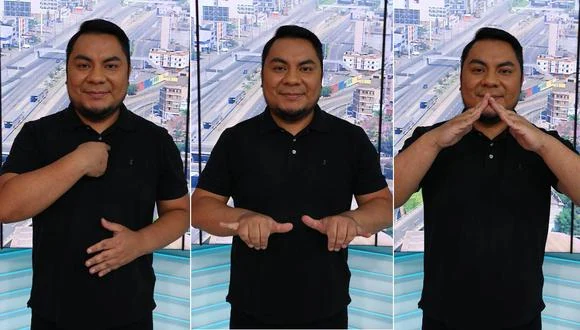
During the State of Emergency facing our country, Moisés Piscoya Arteaga has become one of the most prominent Peruvian Sign Language interpreters, interpreting information from presidential addresses and television programmes for more than half a million people with hearing disabilities. AIEDI interviewed this important interpreter from the Deaf community, who speaks to us about his work in sign language and his ongoing preparation to help create a more accessible and inclusive world.
Could you briefly introduce yourself?
My name is Moisés Piscoya and I am a Peruvian Sign Language interpreter.
What inspired you to learn sign language?
I actually acquired sign language naturally. My mother died shortly after I was born, so I was raised by my older sister. She is Deaf, and she was the person who immersed me in her world, her language and her culture.
How did you get started in sign-language interpreting?
Well, I have interpreted for my sister and her Deaf friends since I was a child, when they needed to go to the doctor or the bank, or complete some procedure. It was somewhat difficult because, through lack of knowledge, people do not know how to interact with a Deaf person or how to work with an interpreter—especially when the interpreter is a child or teenager… As I grew up, I continued to see the difficulties my sister and the Deaf community faced because of the lack of accessibility, even more so than today. I therefore decided to set aside what I was studying at the time and focus on becoming a sign-language interpreter, training myself and acquiring the tools and techniques needed to be a good LSP interpreter, because knowing sign language does not by itself make you an interpreter.
How did the opportunity arise to become the sign-language interpreter for TV Perú programmes?
They issued a call and invited me to take part in the tests to select the sign-language interpreter. A group of other interpreters had also been invited, and in the third week they called me to say that I had successfully passed all the tests and had been selected.
How has your life changed since you began working as a sign-language interpreter on television?
For me, doing this work is extremely important: contributing meaningfully to a more integrated and inclusive society, and enabling Deaf people to know what is happening around them and form their own opinions by receiving information in their language, is rewarding and valuable. I am also very conscious of the enormous responsibility I have. Since working on television, I read as much news as I can, not only from here but from around the world, and I have much more contact with Deaf people who write to me almost all day. But that is part of working on television and being at the service of the Deaf community.
How has your work as an interpreter been affected by the pandemic we are facing?
When the emergency began, President Vizcarra’s addresses and other important information about the pandemic were not accessible, and the Deaf community protested for its rights on social media as never before. This led the channel to extend the interpreting schedule, so I now work three time slots on TV Perú: from 6 to 9 a.m. (now from 9 to 11 a.m.), from noon to 2 p.m., and from 8 to 9 p.m. Getting up at 5 a.m. was very difficult at first, but it is what I have to take on during this time of crisis, and I do so responsibly.
In the current context, Peru’s Deaf Community has implemented the “COVID-19 Volunteer Initiative”, one of whose objectives is to develop new signs because of the pandemic. What do you think of it?
I think it is wonderful. It is a major and important initiative that, as never before, has brought together a group of Deaf leaders not only from Lima but also from different provinces, together with hearing volunteers. This important inclusion project develops specialised terms related to the coronavirus pandemic, and they have already created more than 160 new signs related to COVID-19. This will allow volunteer sign-language interpreters to prepare and be ready to provide high-quality interpreting services when required, thereby helping fulfil the constitutional rights of people with hearing disabilities.
How do you prepare to interpret and adapt the daily “Aprendo en Casa” programmes aimed at children?
Part of sign-language interpreting ethics is preparing in advance: reading the topic, deciding which sign is best for a particular word, and consulting a native Deaf sign-language user when necessary. That is what I do with the “Aprendo en Casa” programmes. I study them beforehand so that I can master the subject and prepare properly to provide the best service, because interpreting for children is even more demanding than usual.
What is the most difficult part of interpreting President Martín Vizcarra’s Addresses to the Nation when they are broadcast live?
If you are not prepared and trained to interpret, it is better not to do it. I work with two languages, Spanish and LSP, so those of us who do this work are essentially bicultural interpreters, because language is closely linked to culture. To convey a message from one language to another, I need to know both cultures. When the president or ministers express an idea, phrase or word that is very specific to their culture, if you do not know how to adapt it to the second culture, it will not be understood. So I need to know not only both languages but both cultures. When the president or ministers say something and I see that there is a cultural gap, I have to bridge it immediately, within a few seconds, because I am interpreting simultaneously. The difficult part is when the audio is poor or too quiet; fortunately, at TV Perú everything is properly set up so I can do my job well.
Do you do any sign-language interpreting work that is not televised?
Yes. Since before the health crisis, I have provided interpreting services for different organisations, government ministries and municipalities at events on human rights, disability or citizen services, either independently or through the company AYLLU LSP INTÉRPRETES. There we have a team of interpreters for interpreting services and Deaf linguistic models who teach LSP.
What should a hearing person bear in mind if they want to learn sign language?
Learning LSP gives you a great opportunity to help create a more inclusive and accessible world and to build communication bridges with more people. It also allows you not only to learn another language but to study Deaf culture. But one very important point is that learning sign language alone is not enough to become an interpreter; you also need a great deal of preparation.
What message would you like to give the Deaf community affected by coronavirus?
Despite the difficult circumstances we are facing, I would tell them to try to remain calm, take all the precautions indicated by the State, stay in contact with people, groups or organisations willing to provide accessibility, and support one another together. Trusting in God’s care and having faith that all this will pass soon, when it does, may we be better people for a better world.