

Content of the article.
As the number of confirmed COVID-19 cases has increased, the Government has gradually implemented measures to prevent its spread and has designated certain benefits for the most vulnerable sectors of the population. Accordingly, on 18 March it approved Supreme Decree No. 005-2020-MIDIS which approves the design of the Support Network for high-risk older adults and persons with severe disabilities..
Among the main points identified in the decree are the following:
- Under Article 3, the bodies that make up this Support Network are the Ministry of Health (MINSA), Ministry of Development and Social Inclusion (MIDIS), Ministry of Women and Vulnerable Populations (MIMP), National Council for the Integration of Persons with Disabilities (CONADIS), EsSalud, SUSALUD, the Armed Forces and Police Health Services, SIS, the National Assembly of Regional Governments, the Association of Municipalities of Peru, the Network of Urban and Rural Municipalities of Peru, Regional Governments and Local Governments, pursuant to Emergency Decree No. 026-2020.
- Under Article 4.2, on the target population, defines Persons with Severe Disabilities as those who “have serious or complete difficulty carrying out their everyday activities and therefore require the support of assistive devices or permanent personal assistance, or assistance for most of the time”.
- Under Article 5, provides that a Priority Services Package will be delivered to Older Adults and Persons with Severe Disabilities in order to mitigate COVID-19 and contain new cases. This package includes:
-
-
-
- Advice on healthy practices and guidance to prevent infection and mitigate the effects of coronavirus (COVID-19), in accordance with the protocol established by the Ministry of Health.
- Identification of warning signs of coronavirus infection (COVID-19).
- Immunisation (pneumococcus and influenza, in accordance with the current vaccination schedule).
- Follow-up of probable cases and investigation of household contacts.
-
-
- Under Article 6, provides that this package will be implemented in three phases:
-
-
-
- Phase 1: Identification and georeferencing of High-Risk Older Adults and Persons with Severe Disabilities.
- Phase 2: Delivery of the priority services package, as applicable.
- Phase 3: Individual follow-up of the target population.
-
-
- Under Article 7, there are several roles in implementing these measures, distributed across local, regional, Metropolitan Lima and national levels.
- Under Article 8, places MIDIS in charge of the management, administration and Monitoring Portal for the Named Register of High-Risk Older Adults and Persons with Severe Disabilities in order to carry out the interventions described above. MIDIS will therefore have real-time access to a range of data to identify beneficiaries of this package. These personal-data databases include: the 2017 Population and Housing Census; the Single Registry for the Identification of Natural Persons (people over 60 years of age) administered by RENIEC; HIS-MINSA (respiratory diagnoses and diagnosis of comorbidities); HIS-DISC-WEB of MINSA; MINSA hospital-discharge and emergency records; the Registry of Death Certificates and Records; the Registry of Disability Certificates; the registry of reported probable cases administered by MINSA; records of services and affiliates administered by Comprehensive Health Insurance (SIS); the Health Insurance Affiliates Registry administered by SUSALUD; SUSALUD service, hospital-discharge and emergency records; the PADOMI Registry and EsSalud service, hospital-discharge and emergency records; the registry of samples for screening coronavirus (COVID-19) cases administered by the National Institute of Health; the telephone-number registry administered by the Ministry of Transport and Communications; and the National Registry of Persons with Disabilities administered by CONADIS, among others.
Además, under the Fifth Final Supplementary Provision, the National Social Inclusion Action Platforms Programme (PAIS) is authorised to expand its lines of intervention in order to promote technical-assistance and coordination actions for the urban population covered by Emergency Decree No. 026-2020 for the duration of that decree.
It should be noted that this is in addition to the measures previously announced by the Peruvian State, which include the continuation of assistance and care services for persons with disabilities (Article 4 of Supreme Decree No. 044-2020-PCM). A fund of 40 million soles has also been granted to contract the services necessary for the organisation and development of a Support Network for High-Risk Older Adults and Persons with Severe Disabilities (Article 2 of Emergency Decree No. 026-2020).
Likewise, on 17 March, the Special Rapporteur on the rights of persons with disabilities, Catalina Devandas, issued a statement on the measures adopted in response to COVID-19, recommending measures concerning persons with disabilities that States should follow.
Infographic on the recommendations of the Special Rapporteur on the rights of persons with disabilities, Catalina Devandas, in response to COVID-19.
[caption id="attachment_14716" align="alignnone" width="800"]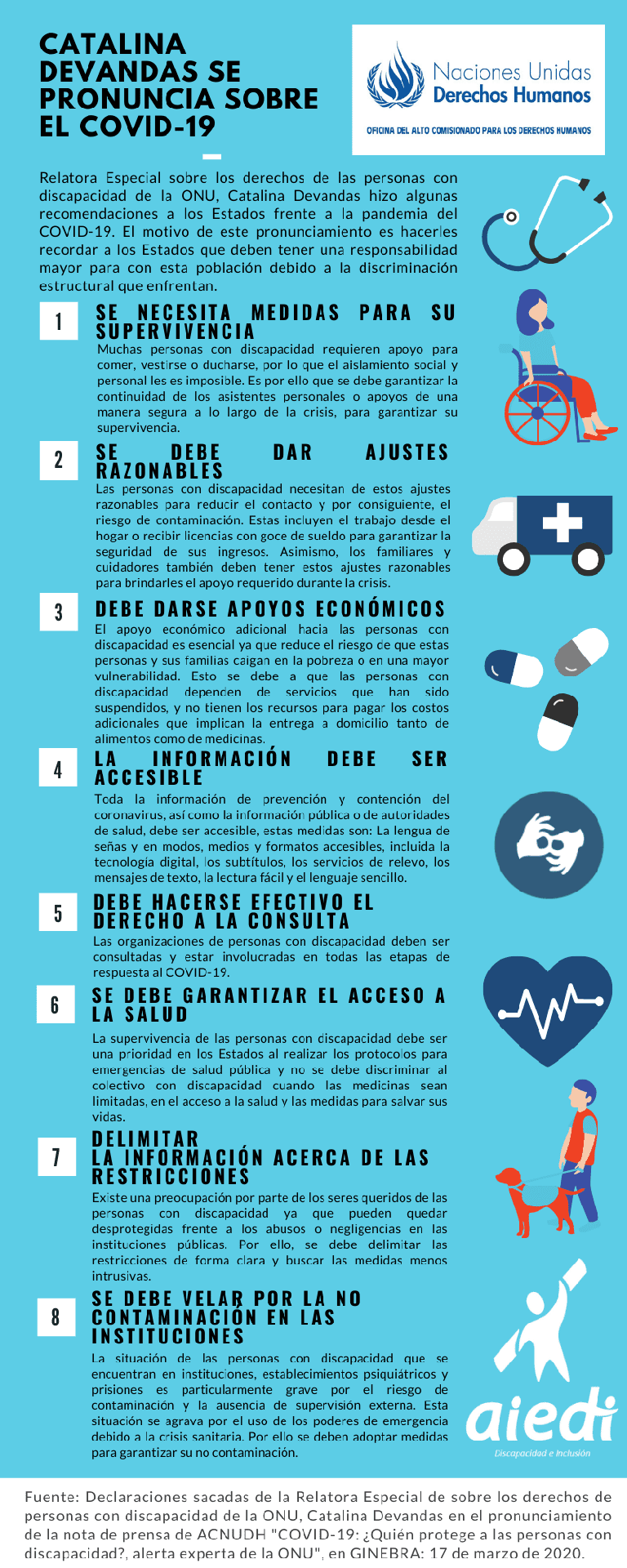 Infographic on the recommendations of the Special Rapporteur on the rights of persons with disabilities, Catalina Devandas, in response to COVID-19.[/caption]
- If you cannot read the infographic, you can access our Facebook post by clicking:
Do you think that all these measures adopted by the Peruvian State are appropriate or consistent with the recommendations of the UN Special Rapporteur on the rights of persons with disabilities?
[UPDATE: 19 MARCH]
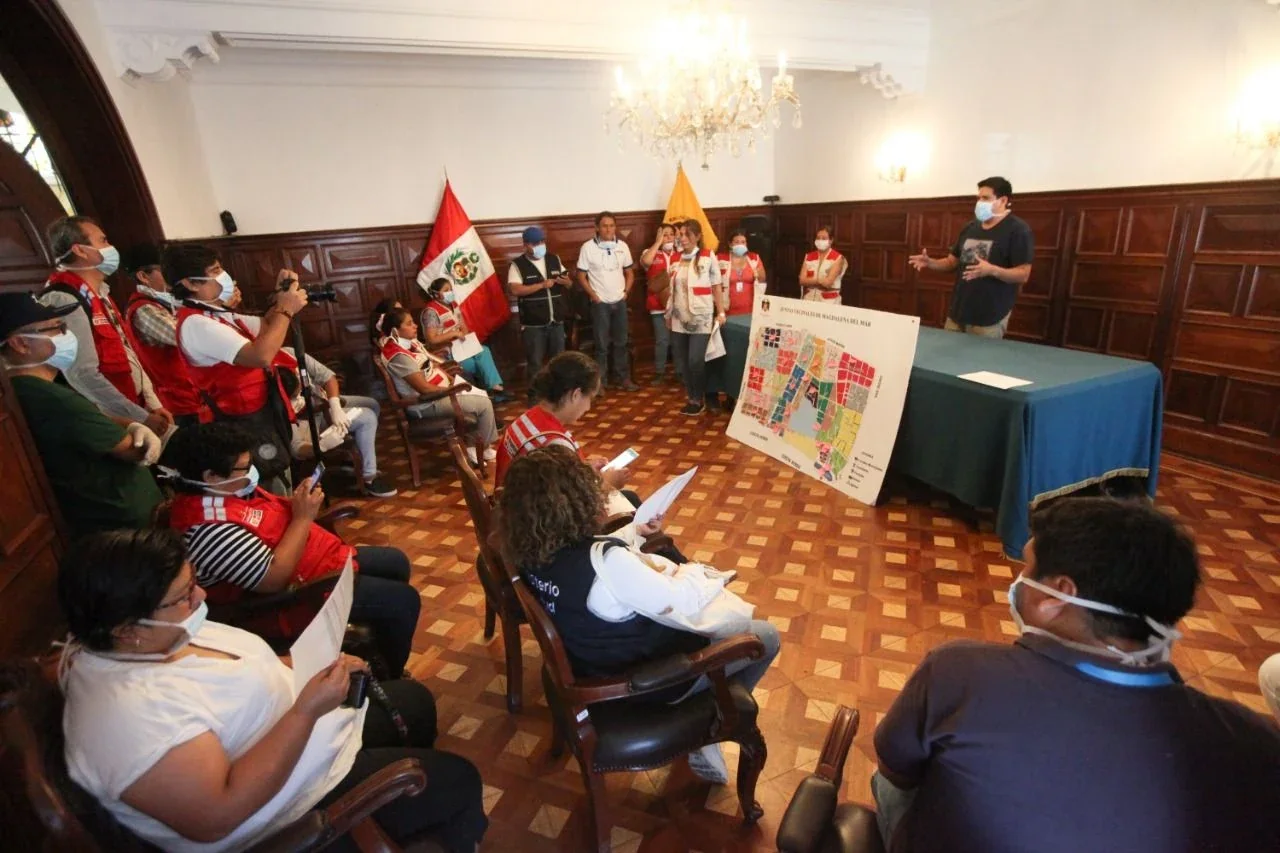
According to the MIDIS General Office of Strategic Communication, a pilot implementation of the network was carried out in Barranco and Magdalena del Mar, with the intention of scaling it to municipalities in urban areas, given that the virus was present in those areas.
The pilot reported that telephone calls would be used to provide education on care practices that reduce risk, ask about people’s health status, and identify symptoms and risk situations; home visits would be made to people who could not be contacted by telephone and/or did not have a telephone number recorded in the named register. (MIDIS - GOB.PE: 2020)
If you would like to read Supreme Decree No. 005-2020-MIDIS in full, click the following box: