
Content of the article.
On Tuesday, 18 February, the “Beach for Everyone” project located in the district of Chorrillos was inaugurated. This initiative is driven by an alliance involving the National Council for the Integration of Persons with Disabilities – CONADIS and made possible by investment from the private companies SODIMAC and MAESTRO.
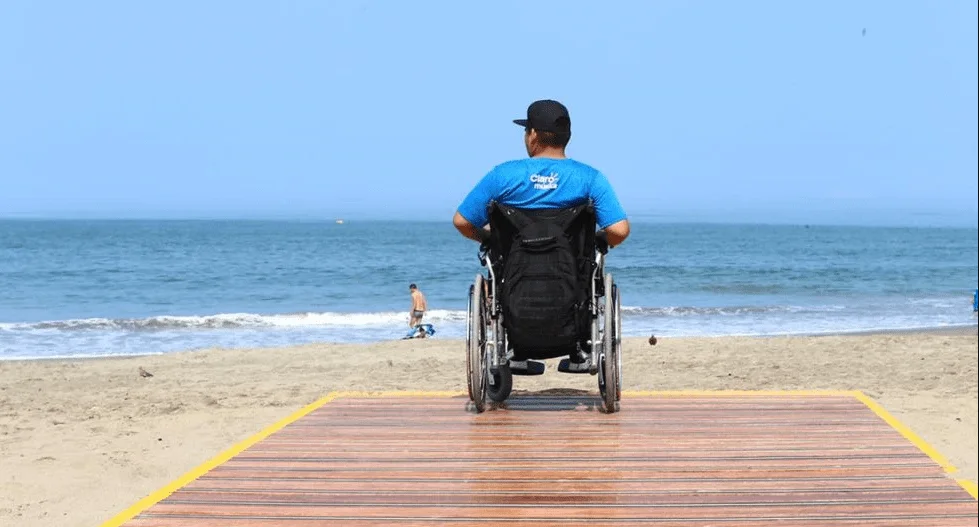
This accessible beach has a wooden ramp. In this regard, Espacio Accesible (a company specialising in Accessibility and Universal Design) states that this “design consisted of a wooden platform with a 40-metre walkway ending 20 metres from the shoreline” (Espacio Accesible: 2020) and it also has six universal-design platforms, a haptic map, tactile paving strips, Braille signage with audio QR codes, an audio and visual emergency system, an accessible toilet, safety railings and various adaptations that enable persons with disabilities and people with reduced mobility to enjoy the beach. In coordination with the Municipality of Chorrillos, the necessary adaptations were also made to access routes from public- and private-transport entry points in order to create an accessible route from the entrance to the sand and facilitate access to the beach for persons with disabilities. The municipality is also responsible for lifeguard services, security and safeguarding the equipment installed in the accessible beach area.
Likewise, according to the newspaper CORREO, “the design also included 8 reserved parking spaces (4 for persons with disabilities and 4 for people with reduced mobility), which are properly signposted and comply with the required dimensions.” (CORREO: 2020)
If you missed the inauguration, you can see everything that happened on the Municipality of Chorrillos Facebook page. Just click the following post:
To provide you with all the relevant information about this “priority area” at Agua Dulce Beach, we contacted Giovana Osorio (hereinafter, Giovanna) and Ronald Osorio (hereinafter, Ronald), both members of the Asociación Psico-incclusiva KipuLlaxta to tell us about their expectations and experiences before and after the inauguration.
-
Questions asked before visiting the Beach for Everyone[1]:
1. What do you expect, or what are your expectations, for the inauguration of the “Beach for Everyone”?
Giovanna: I hope it will be an inspiring initiative that includes more accessibility features than previous initiatives in our country. I like that it is called a beach for everyone, although using that term gives this project a major challenge: learning how to make an environment respectfully welcome functional, cultural and individual diversity. I hope they meet that challenge.
Ronald: If it is well received, I hope other beaches in Peru can achieve a higher level of accessibility. First, because there is strong demand for beaches with a higher average level of accessibility and virtually no supply. Second, if there is a model of an accessible beach, others can replicate it because there will already be experience, it will be possible to see how people receive it, gather feedback and apply benchmarking.
2. Other beaches, such as Miraflores and now Ancón, claim to be inclusive. From your perspective, do you consider them inclusive?
Giovanna: I consider them two initiatives with some important accessibility features. That is very positive, but from what I have been able to see, in my view important components are still missing before they can truly be considered inclusive beaches. For me, inclusion has two strong pillars: universal accessibility and full and effective participation. I feel that Peru has not yet achieved beaches with both of those strong pillars, although we are taking some important steps.
Ronald: Accessibility exists in degrees. It cannot simply be described as accessible or inaccessible. To be more objective, let us start from the Royal Spanish Academy’s definition of a beach: “The shore of the sea or of a large river, formed by sandbanks on an almost flat surface.” Based on that, I can say:
a) At Miraflores, as far as I know, people with severe reduced mobility do not have direct contact with the beach; they remain on a concrete surface about 10 metres from the water. It is more like a seaside viewpoint that is more accessible than those in other places. Consider the Royal Spanish Academy’s definition of a viewpoint: “A well-situated place from which to contemplate a landscape.”
b) Ancón is more accessible than other beaches in terms of direct contact with “the seashore” for people with reduced mobility. However, if we look at the accessibility chain as a whole, it is not. A beach accessibility chain has at least 10 links. If Ancón Beach does not have a toilet for persons with disabilities or an accessible restaurant nearby, it would be meeting only one link in that chain. And I do not know to what degree even that link is satisfied. I do not want to take an overly critical position toward those investing in inclusion; it is better to focus on those who are not and to advise those who are on how to improve.
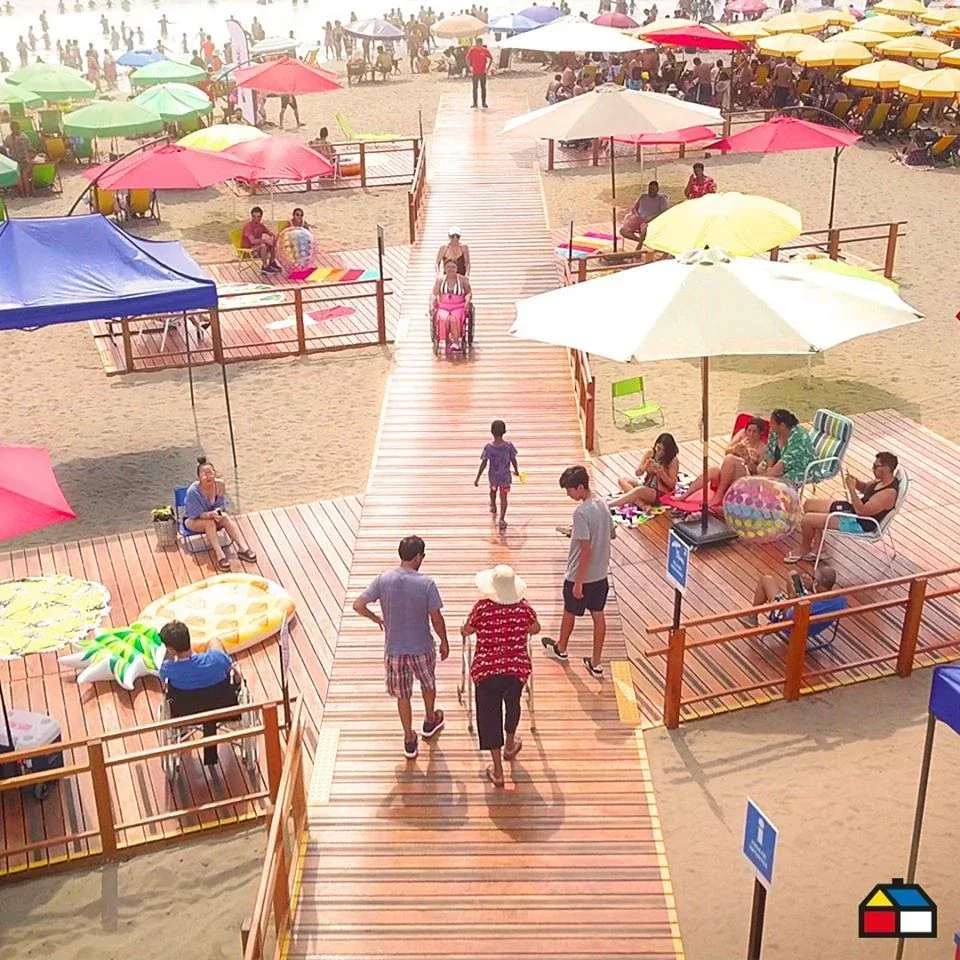 Photo of the Beach for Everyone.
Photo credit: SODIMAC Homecenter - Facebook page[/caption]
After the inauguration of the “Beach for Everyone” on 18 February, we contacted Ronald Osorio from KipuLlaxta, who attended the event and told us about their experience.
-
Questions asked after visiting the Beach for Everyone[2]:
1. What impressed you about the Beach for Everyone? Was the design presented to the associations implemented as proposed, or did it change?
Ronald:
a) What impressed me:
- Seeing so many persons with disabilities together at a beach. That shows the demand for beaches like this.
b) The design was not implemented in full.
-
- Negativo:
-
- The section closest to the shoreline: amphibious wheelchairs.
-
- Positivo:
-
- It is much larger than the design presented. The islands and walkways (wooden-board paths) are much wider. This provides a larger accessible area for people with reduced mobility.
-
- Negativo:
However, I heard more than one attendee—not a direct official source—say that there was a commitment to continue implementing features that would add accessibility to the beach.
2. Does it meet the needs of diverse users?
Ronald: There are different forms of diversity and, in my view, needs are met to different degrees. Speaking specifically about severe reduced mobility, which is part of physical functional diversity and an area in which I have years of experience, I can say the following:
- It brings me to within a few metres of the shoreline. I can travel the 40-metre walkway five times from the entrance to the end, a few metres from the shoreline, easily and quickly.
- It was also easy for the person driving my wheelchair. I normally make that trip with two people helping me, sweating, and it takes several minutes.
- It will also be useful for people who use other mobility aids, such as baby strollers or walking sticks.
- I heard wheelchair users say that they want an access ramp into the sea. (More information in 2.2.)
2.1. Is tactile paving installed in strategic locations?
Ronald: There is tactile paving before the downward slopes of ramps on the pavements and at the walkway ramps. There is no continuous tactile route.
2.2. Does the path reach the sea? Are appropriate amphibious wheelchairs available? Are there adequate measures for people with visual disabilities?
Ronald: The walkway does not reach the sea, and in many accessible beaches—even in Europe or the United States—walkways generally do not extend into the sea. Paths usually reach the point where the tide rises. This is done for logistical reasons. Ramps that enter the sea require more maintenance because of direct contact with waves, which reduces durability due to moisture and friction. I am not justifying their absence; I am simply explaining the reason.
There are no amphibious wheelchairs. To determine how necessary amphibious wheelchairs are for a consumer with a disability, it is better to quantify the need and try to be as objective as possible. The questions should therefore be: Would you use an amphibious wheelchair? How often? In my case, the answer would be yes (if the water is clean, and DIGESA says that Agua Dulce is suitable for bathing). How often would I use it? I would be satisfied with twice in my life. I am not a beach enthusiast.
Additional information. There were no amphibious wheelchairs, but there were competitive rowing boats that, at the time, were used by people who had participated in the Paralympic Games. I imagine they were there for use during the inauguration.
There is raised-letter and Braille signage. Tactile paving is present at ramp level changes. There is no continuous tactile path. The edges of the walkways are painted yellow (I read that yellow adhesive strips were used). This measure helps people with low vision, though not people with total vision loss, and to some extent people with cognitive disabilities.
2.3. Are sign language interpreters available for services?
Ronald: I do not know, but personally I did not see any sign language interpreter. I also did not see people with hearing disabilities using sign language. What I do know is that interpreters will be available for educational services (workshops) until 15 March. In addition, there will be a workshop in which people can learn how to say things in sign language.
3. What should be improved overall?
Ronald: The most basic points:
- The toilet for persons with disabilities could be improved considerably (I am describing the only one I saw. At present I do not know whether there will be more),
- amphibious wheelchairs, based on the comments I heard,
- staff who use sign language (if there are none; interpreters will be present in the workshops), more tactile paving, and a larger sign so that the beach can be located from the street.
I have heard in news reports and from members of the public who attended that the authorities said this is only the beginning and that the beach will be improved gradually. To date, I have not heard that directly from an official source.
As noted in the information provided, the inauguration was attended by the Minister for Women and Vulnerable Populations, Gloria Montenegro Figueroa, and the mayor of Chorrillos, Augusto Sergio Miyashiro. It was also attended by Mario Hung Fung, Director-General for Accessibility and Technology at the Ministry of Housing, Construction and Sanitation; Luisa Villar, President of the Peruvian National Paralympic Association; and representatives of SODIMAC and MAESTRO.
[caption id="attachment_7121" align="aligncenter" width="1000"]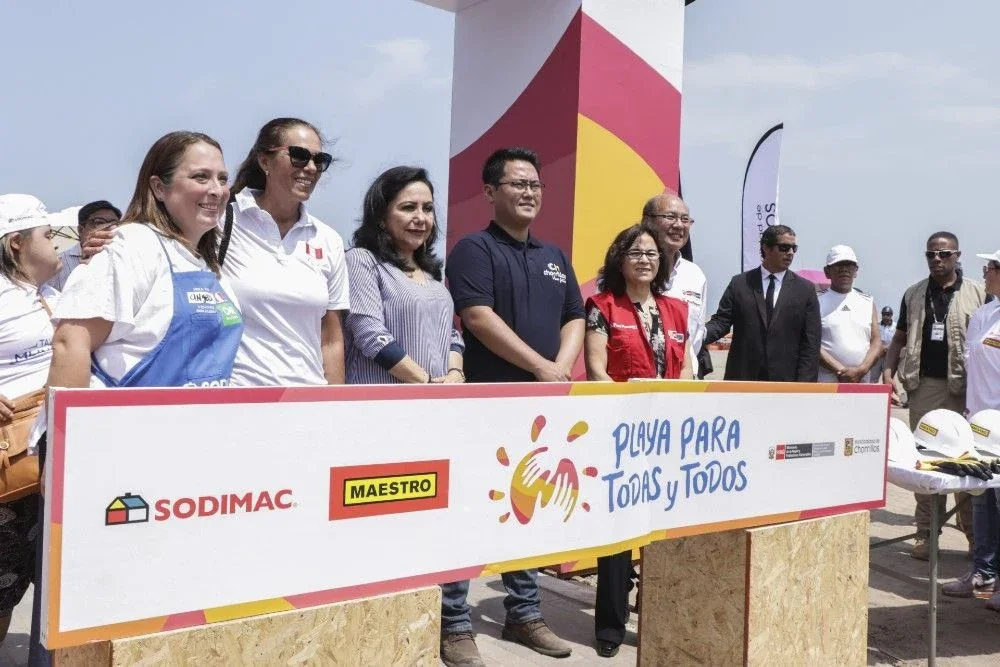 Photo of the inauguration of the Beach for Everyone. Photo credit: taken from Isela Barranzuela Chuica’s article in Mercado Negro.[/caption]
Likewise, to learn everything about the accessibility level of the “Beach for Everyone” project and the steps required to make a beach inclusive, we contacted Gálata Llano (hereinafter, Gálata), General Manager of Safe City, a company specialising in accessibility, and the Accessibility Institute - Specialised training.
-
The questions asked were[3]: