
Content of the article.
International Deafblindness Day has been commemorated on 27 June each year since the “Declaration of the Basic Needs of Deafblind People” adopted in Stockholm, Sweden, in 1989. The declaration also paid tribute to Helen Keller, “who represents a successful model of a deafblind person, as she was the first person with these disabilities to graduate from a university” (Government of Mexico, 2017).[1].
The principal aim of this commemoration is to make the needs of deafblind people visible in order to implement strategies that facilitate their inclusion and encourage government attention to needs arising in different areas, such as environmental, medical, social and, particularly, educational contexts. Many deafblind people are unable to access quality education[2] because of barriers such as communication difficulties between deafblind students and teaching staff, and a shortage of qualified professionals with sufficient competencies, capacities and skills to provide appropriate educational support to deafblind students.
In Peru, Law No. 29524, the Law Recognising Deafblindness as a Unique Disability in Peru, was approved on 1 May 2010. The law recognises finger spelling and Braille, together with other alternative systems, as communication systems. It also establishes the need to create guide and interpreting services and recognises orientation and mobility techniques and other alternative communication systems validated by the Ministry of Education in order to facilitate deafblind people’s access to public services.[3].
To mark this date, AIEDI presents the characteristics of deafblindness and the way it affects the education system.
What do we know about this disability?
Deafblindness is a disability resulting from the combination of visual and hearing impairments. It manifests in different degrees and causes unique communication difficulties. Deafblind people have specific needs because of difficulties perceiving, understanding and navigating their environment, and therefore require specialised services, qualified personnel and specific communication methods (Fernández-Valderas et al., 2017).
As Álvarez et al. (Álvarez, Daniel; Arregui Noguer Beatriz; Cenjor Españo Carlos; García Dorado Myriam; Gómez Viñas, 2004) note, deafblind people may have difficulty perceiving what is happening around them. They often require the assistance of sign-language interpreters (ILSES).
From the perspective of education, it is important to highlight the use of signs and curricular adaptations. Deafblind students, like everyone else, are individuals with their own strengths and weaknesses; nevertheless, there are some needs common to deafblind people that must be considered by those responsible for providing educational support (Riggio et al., n.d.). The combined loss of hearing and vision may produce isolation for deafblind students. One challenge for teaching staff is therefore not only to address feelings of rejection and isolation, but also to design and implement strategies that give students effective means of communication so that they can develop and demonstrate their competencies.
Communication is therefore a key factor in access to the curriculum, including through pre-symbolic forms such as a student’s gestures and gaze, sign language, visual and tactile finger spelling, Braille, materials using alternative communication systems, and the sign language used in each country.
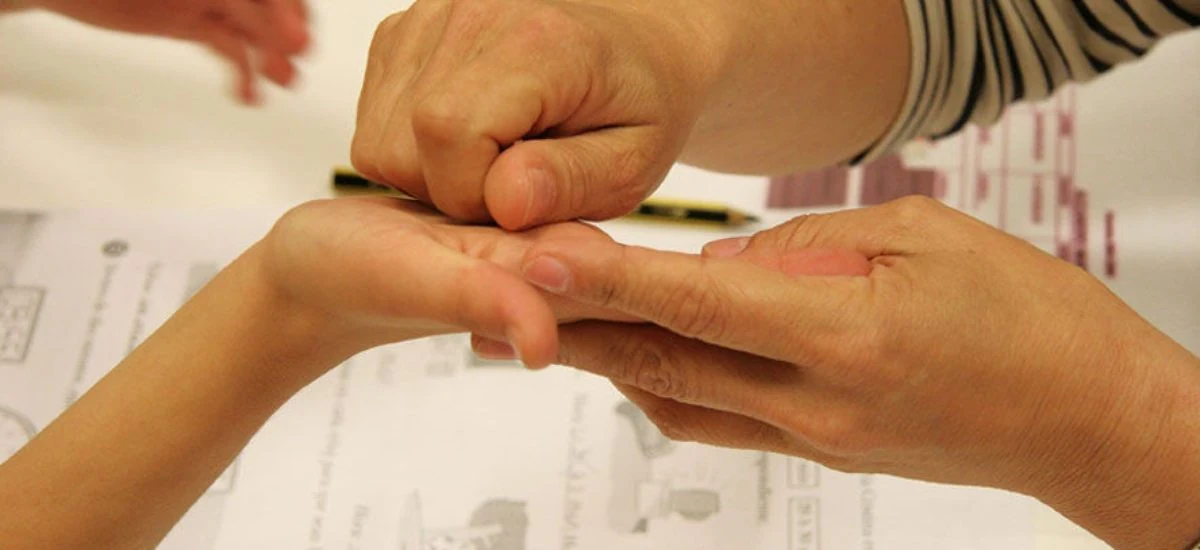
For a deafblind person, the sensitivity of the fingertips and hands can become an especially valuable resource. In this regard, one of the leading disability researchers, Michael T. Collins,[4]emphasised a “Resource Guide for the Educational Support of Deafblind Students”,[5]which identifies the need for every educational team to include a professional specialised in deafblindness who can provide direct support as well as assistance and training to families, education professionals and therapists. The guide was prepared by Marianne Riggio and Barbara McLetchie in memory of Michael T. Collins. It offers recommendations that teaching staff should have the competencies, capacities and skills required to meet educational and communication needs. Deafblind students may receive educational support from different professionals, including special-education teachers, classroom teachers, teachers of people with visual impairments, and teachers of Deaf and hard-of-hearing students. They may also receive support from speech and language professionals, physiotherapists and/or occupational therapists.
Finally, it is important to mention the agreement[6] signed between MINEDU and Sense International Peru[7] in the context of International Deafblindness Day. The agreement aims to train 900 teachers who support deafblind students over a three-year period. To this end, the online course “Strategies for Supporting Deafblind Students” will be implemented for special-education teachers and teachers in inclusive educational institutions and delivered through the platform PerúEduca with experts in the field.
References:
[1]Gobierno de México. Retrieved from: https://www.gob.mx/conadis/es/articulos/hellen-keller-dia-internacional-de-las-personas-sordociegas?idiom=es (last accessed on 30 June 2020).
[2] Fundación ONCE. Retrieved from: https://www.once.es/servicios-sociales/sordoceguera/que-necesitan-las-personas-con-sordoceguera. (last accessed on 30 June 2020).
[3] CONADIS. https://www.conadisperu.gob.pe/notas-informativas/27-de-junio-dia-internacional-de-la-sordoceguera (last accessed on 30 June 2020).
[4] He was director of the Perkins School for the Blind in Watertown, Massachusetts, the oldest school for persons with visual disabilities in the United States. https://www.perkins.org/. (last accessed on 30 June 2020)
[5] Perkins School for the Blind. Retrieved from: http://www.perkinsla.org/es/blog-details.php?id=54&seccion=biblio. (last accessed on 30 June 2020)
[6] Diario Andina. Retrieved from: https://andina.pe/agencia/noticia-capacitaran-a-900-docentes-atienden-a-estudiantes-sordoceguera-803314.aspx. (last accessed on 27 June 2020).
[7] http://www.senseintperu.org/. Sense is a non-profit organisation based in England. It began in 1955 as a self-help and support group for parents of children with deafblindness. Sense directly provides specialised services to people with deafblindness, their families, caregivers and the professionals who work with them. It also supports people with sensory impairments and additional disabilities. Sense International’s presence in Peru began in 1996 through individual support provided to existing rehabilitation programmes for people with deafblindness and multiple sensory disabilities, and continued in 2004 with the opening of a branch in Lima. In July 2009, Sense International established an autonomous association named Sense International (Peru), headquartered in Lima.
Bibliography:
Álvarez, Daniel; Arregui Noguer Beatriz; Cenjor Españo Carlos; García Dorado Myriam; Gómez Viñas, P. M. H. E. (2004). La sordoceguera. Un análisis multidisciplinar. In O. Organización Nacional de ciegos españoles (Ed.), La sordoceguera. Un análisis multidisciplinar (1°).
Fernández-Valderas, C., Macías-Seda, J., & Gil-García, E. (2017). Experiencias de las personas sordociegas sobre la atención sanitaria. Enfermeria Clinica, 27(6), 375–378. https://doi.org/10.1016/j.enfcli.2017.03.011
Riggio, M., Mcletchie, B., Co-Autores, E., Belote, M., Collins, M., Edelman, S., Kappen, B., Leslie, G., Evans-Luiselli, T., Mason, B., Mcginnity, B., Miller, T., Perreault, S., Silberman, R., Zatta, M., De Contenido, A., Anderson, H., Davidson, R., Peracchio, J., … Pugh, G. (n.d.). Sordoceguera: Guia De Recursos Para La Atención Educativa. 146.