

Abstract: Starting from the obstacles identified in the community that prevent persons with disabilities from fully enjoying the right to education—including the development of effective communication—this article examines the role of implementing augmentative communication methods and highlights the importance of using pictograms as a means of applying an innovative educational methodology for persons with disabilities in our country. It describes different uses of pictograms and experiences such as that of the Government of Aragon in Spain, which makes a range of online tools—pictograms, materials and software—available to the public. That experience is proposed as a possible starting point for Peru’s education system for children who have difficulty communicating or who cannot speak, including children with cerebral palsy, Asperger syndrome and autism spectrum disorder.
Keywords: Pictograms, teaching strategy, augmentative and alternative methodology.
Article content.
Civil society and major institutions such as Peru’s Ministry of Education have carried out a series of special-education practices and actions intended to move progressively toward inclusive education. Experience in the private sector, together with State investment, has produced valuable initiatives such as those at Colegio Fe y Alegría, the Ann Sullivan Center of Peru (CASP) and the Kallpa Special Education Centre, all of which serve persons with disabilities. It is important to understand that inclusion in education does not mean merely placing everyone in the same space; it means adopting a positive outlook and attitude toward human diversity. Disability fits perfectly within that understanding as one more form of diversity that enriches and builds society (Tovar, 2006).
To strengthen this inclusion process, teachers need training and new methodological strategies must be adopted so that, pedagogically, children included in mainstream settings can genuinely learn. One central gap in this difficult work is enabling students with disabilities to communicate with teachers in ways suited to their disability. One path toward an inclusive approach is to promote strategies such as pictograms, which concern not only the student but also teachers, support specialists, families of persons with disabilities and the wider educational community.
In this context, it is useful to define what a pictogram is and how pictograms are used. A starting point is that pictograms are tools that provide cognitive accessibility by making the world easier to understand. A pictogram can also be defined as an iconic sign that is primarily visual, conveying meaning simply and clearly across cultural, linguistic or cognitive boundaries. Pictograms often have meanings understood broadly while also taking cultural and social meanings into account (García & La Cruz, 2015). Pictograms are used in different settings, for example in signage and communication.
In the first case, pictograms can be found in shopping centres, recreational venues or breastfeeding areas. One characteristic of this use is that no specific training is needed to understand them because people encounter them from an early age. An example is the pictograms used to distinguish men’s and women’s facilities. This use of pictograms provides clear information about places, objects or actions, thereby helping create more inclusive spaces, and should be understandable to as many people as possible.
The second case, which is the focus here, concerns pictograms used for communication. Some persons with disabilities, including people with autism spectrum disorder (hereinafter, ASD), Asperger syndrome, cerebral palsy and other disabilities, may experience delayed or absent spoken language, and some cannot speak. This makes it necessary to use augmentative and alternative communication systems. Pictograms form part of these systems. Pictographic symbols, in which the intended referent is represented graphically in a simple way, are among the resources most commonly used in augmentative and alternative communication (Beukelman and Mirenda, 2013).
At this point it is useful to briefly define cerebral palsy (hereinafter, CP), autism spectrum disorder and Asperger syndrome.
Cerebral palsy is a persistent (although not invariable) motor disorder affecting the development of postural tone and movement that results in activity limitation, secondary to a non-progressive injury in an immature brain and frequently accompanied by other comorbidities whose presence or absence significantly influences each child’s prognosis (Li Hurtado, 2007).
According to Rapin Katzman (1997), autism spectrum disorder is not a disease but a clinical syndrome present from the first months of life, involving alterations in behaviour, verbal and non-verbal communication, and atypical social and emotional interaction. It may involve significant delay in language acquisition and inappropriate use of words without an adequate communicative purpose. Autism does not represent a single pathological process but a constellation of symptoms that may arise from different conditions.
Continuing along the same lines, it is useful to define Asperger syndrome. Naranjo Flórez notes that Asperger syndrome is a pervasive developmental disorder described by Hans Asperger in 1944. It is characterised by marked social impairment, communication difficulties, deficits in play skills, and a range of repetitive behaviours and interests, without significant language or cognitive delay.
In conclusion, autism spectrum disorder, Asperger syndrome and cerebral palsy are three conditions with certain common characteristics that, when interacting with different types of barriers, can give rise to disability. In light of this, educational strategies should be adopted to foster the abilities and potential of persons with disabilities during learning, with pictograms serving as an innovative strategy in that process.
One example of the use of pictograms is found in the Government of Aragon in Spain. There, an augmentative and alternative communication centre known as ARASAAC has been created and, with support from the European Union, has implemented a range of graphic resources so that persons with disabilities can access a better system of online education. In simple terms, ARASAAC provides an open public space and a repository of quality content related to Augmentative and Alternative Communication, supporting free learning through software tools and pictograms. Anyone can use the pictograms in the repository under ARASAAC’s own Creative Commons licence, which has encouraged the creation of free applications for PCs and mobile devices. One example is ARAWORD, a word processor using pictograms, reflecting the principle that communication is for everyone.[1].
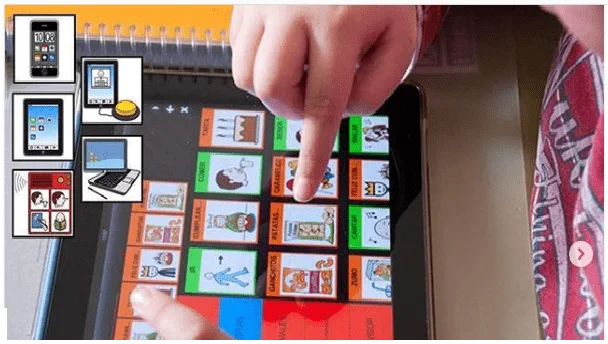
Source: ARASAAC[2].
Last year, ARASAAC received Spain’s National Autism Award in the category of rights advocacy and good practices. The award highlights the value of the initiative because it significantly improves the quality of life of people with autism spectrum disorder and their families.
It is important to emphasise that pictograms are used in the teaching and learning process for children with disabilities. Cabello & Bertola (2015) note that pictographic symbols are well known in Spain because they are used in many types of materials, communication notebooks and augmentative and alternative communication software, such as Araboard.[3].
A study presented by Mogollón (2016) focused on adapting teaching strategies through pictograms in order to facilitate primary education for children with ASD at the Instituto Técnico Guaimaral in Cúcuta, Colombia, an official coeducational institution providing preschool, basic and technical secondary education and offering quality inclusive education. The research produced a booklet of traditional stories using pictograms, thereby encouraging children’s literature among autistic children and reinforcing its use in the classroom.

Source: Aula Autista[4].
One scientific finding from the study cited above is that an increase in the number of students with disabilities can leave teachers without enough time to provide individualised learning for every student; this is compounded by a lack of resources for working with students who have different characteristics. Stories adapted through pictograms offer an option for creating new spaces for interaction and knowledge in education, and can enable students with disabilities to achieve meaningful learning in which creativity and imagination are encouraged and needs are addressed in a personalised manner.
It is therefore useful to define an augmentative and alternative communication system (hereinafter, AAC). Such systems support the development of communication skills in persons with language-related disabilities (Guisen and Sanz, 2014). Centeno, Bautista and Díaz (citing Von Tetzchner, 1993) note that an augmentative and alternative communication system can function as supportive language for people who experience difficulties in language development, such as children with Down syndrome.
These are forms of expression other than spoken language whose purpose is to increase (augmentative) and/or compensate for (alternative) communication and language difficulties experienced by many persons with disabilities. Conditions that may make an AAC system necessary include cerebral palsy (CP), intellectual disability, autism spectrum disorders (ASD), neurological diseases such as amyotrophic lateral sclerosis (ALS), multiple sclerosis (MS) or Parkinson’s disease, muscular dystrophies, traumatic brain injuries, aphasia and others.
Continuing along the same lines, resources used in AAC can include symbol systems such as pictograms. This highlights the importance of communication support products, which often include technological resources such as tablets with specialised software allowing different forms of access and adaptation for people with very limited mobility, including people with cerebral palsy. In Peru, Legislative Decree No. 1465-2020 establishes measures to guarantee continuity of educational services within the framework of preventive government actions to avoid the spread of COVID-19. Article 2 authorises the Ministry of Education (MINEDU), through Executing Unit 120: National Programme for the Provision of Educational Materials, to acquire computer and/or electronic devices for delivery to selected public educational institutions. Nevertheless, it is equally urgent for the Peruvian Government to promote the distribution of technological devices that incorporate pictographic systems for persons with disabilities, particularly those with limited economic resources.
For that reason, I also consider it necessary to establish educational protocols for persons with disabilities that take account of two basic points: first, the use of pictograms in the education system for persons with disabilities, complemented by ICT; and second, disability-specific educational-support protocols that give teachers guidelines for teaching students with disabilities such as ASD, cerebral palsy, Down syndrome and others.
I conclude by noting that pictograms in educational settings should become part of the daily lives of students with disabilities and appear in all the spaces they use, both in the classroom and in other places they frequent. Their use has spread rapidly across different States, associations and foundations. The consolidated work of the ONCE Foundation, which has produced a manual with basic guidelines for their use, is particularly valuable. Peru, however, still shows a major gap in the educational support provided to students with disabilities, who require specialised educational responses. Pictograms can help generate quality educational responses because communication is one of the principal barriers in the educational process of a person with a disability.
Bibliographic references:
[1] ARASAAC, (2020) Available at: http://www.arasaac.org/. Reviewed on 09/05/2020.
[2] Aula Abierta ARASAAC. Available at: http://aulaabierta.arasaac.org/materiales-caa#competencia%20ling%C3%BC%C3%ADstica. Reviewed on 09/05/2020.
[3] Araboard is a set of tools designed for augmentative and alternative communication. Its purpose is to facilitate functional communication through images and pictograms for people who experience communication difficulties. It can also be used to create routine boards and boards for participating in planned tasks. Araboard enables users to create, edit and use communication boards on different devices (computer, smartphone or tablet). Available at: http://aulaabierta.arasaac.org/araboard-para-pc-y-para-dispositivos-moviles-2-instalacion Reviewed on 09/05/2020.
[4] Aula abierta (2020) Available at: http://www.aulautista.com/2011/02/28/conociendo-mejor-arasaac/. Reviewed on 09/05/2020.
Bibliography:
Beukelman, D., y Mirenda, P. (2013). Augmentative and alternative communication: Supporting children and adults with complex communication needs. Baltimore, MA: Paul H. Brookes Publishing Co.
Cabello, Francisco & Bertola, Elizabetta. (2015). Características formales y transparencia de los símbolos pictográficos de ARASAAC. Revista de Investigación En Logopedia, 5(1), 60-70.
Centeno, Hernán Darío, José Luis Bautista Zambrano, Juan Carlos Díaz Ordóñez, & Gabriela Estefanía Román Santamaría. (2018). Inclusión de pictogramas con la metodología aumentativa alternativa en el desarrollo de un tablero de comunicación para niños con Sídrome de Down. Novasinergia, 1(1), 51-58.
García, J. M. P., & de la Cruz, L. L. (2015). La lectura fácil: una apuesta de valor para las organizaciones. Revista Española de Discapacidad (REDIS), 3(1), 187-192.
Guisen, M. & Sanz, C. (2014). Diseño de ECCA (Entorno Colaborativo de Comunicación Aumentativa y Alternativa). Una ayuda tecnológica para alumnos con Necesidades Complejas de Comunicación. Edutec-e, Revista Electrónica de Tecnología Educativa, 50, 1-16.
Li, Hurtado. (2007). La parálisis cerebral infantil. Actualización del concepto diagnóstico y tratamiento. Pediatría Integral; XI (8): 687-698.
Mogollón Gauta, Diana Carolina, (2016). Estrategias pedagógicas dirigidas a maestros para incentivar la literatura infantil de niños y niñas con autismo en educación básica primaria del Instituto Técnico Guaimaral de la ciudad de Cúcuta Norte de Santander. Hexágono Pedagógico, 7(1).
Naranjo Flórez, Ricardo Andrés. (2014). Avances y perspectivas en Síndrome de Asperger. Nova, 12(21), 81-101. Retrieved May 06, 2020, from http://www.scielo.org.co/scielo.php?script=sci_arttext&pid=S1794-24702014000100007&lng=en&tlng=es.
Rapin I. Autism, current concepts.N Engl Jour Med 1997;337:97-104
Tovar Samanez, T., & Fernández Castillo, P. (2006). Aprender vida : la educación de las personas con discapacidad. Comisión Especial de Estudio sobre Discapacidad del Congreso de la República.