
Summary: The “social model” of disability is usually understood as a way of conceptualising disability in order to take action in the contemporary world toward the inclusion of persons with disabilities in different areas of everyday life. As often happens when rights become institutionalised, their dissemination can leave aside the historical struggle that made possible not only their consolidation at the international level but also the different ways in which those struggles were carried out around the world according to the particular contexts in which they developed. This text makes a brief effort to highlight their character as a political process that continues to this day, despite transformations across time and place, and then turns to Latin America and Peru in order to reflect on collective paths that go beyond institutional channels.
Keywords: Disability, social model of disability, social movements, popular struggles, Latin America.
Introduction.
As with any right recognised in the contemporary world, the rights of persons with disabilities and the recognition of their autonomy were also won through organised collective action. The second half of the twentieth century witnessed processes of struggle that, like others, required indignation, political understanding and organisation, yet these processes have become relatively invisible in the history of the rights of this population. In the present century, rights advocacy has become institutionalised[1], and the sociohistorical conditions surrounding those processes have changed, transforming the processes themselves. It is worth attempting a general reading of this development.
-
Disability awakens in the United States
It was the United States Independent Living Movement (hereinafter, the “ILM”) that initiated a new way of understanding disability through social relations rather than solely through the individual characteristics of the person concerned. The social conception of disability essentially responded to an earlier model that treated individuals as objects of medical attention (Palacios, 2008), revealing disability’s political character and challenging common assumptions with consequences for people’s lives.
What is known of this social movement is that it began and gained momentum in education in the early 1970s. At a time when cities were hostile environments for people with disabilities, the University of Illinois at Urbana-Champaign provided accessible spaces for young people with disabilities (DeJong, 1979). At the University of California, however, a student with a disability, Ed Roberts, applied independent-living philosophy “to himself”, coordinating efforts that enabled him to study (Martínez, 2003).
During those years, beyond the struggle for accessibility accommodations, another struggle emerged: obtaining recognition of rights from the State so that it would guarantee them, and recognition by society at large of the status of person . After the Education Committee refused Judith Heumann a teaching position because she used a wheelchair, she took legal action through an organisation of persons with disabilities called “Disabled in Action” (Heumann, 2003). Heumann recounts in the film “Crip Camp” that her activism and capacity to help lead this mobilisation were influenced by her experience at a camp for young people with disabilities organised by hippies that enabled the group to explore autonomy outside the control of medical confinement and family overprotection. There, participants understood that what they needed to carry out everyday activities—as any person without a disability does—was physical support, mutual assistance and equal treatment: factors located outside their bodies and within their relationships with others.
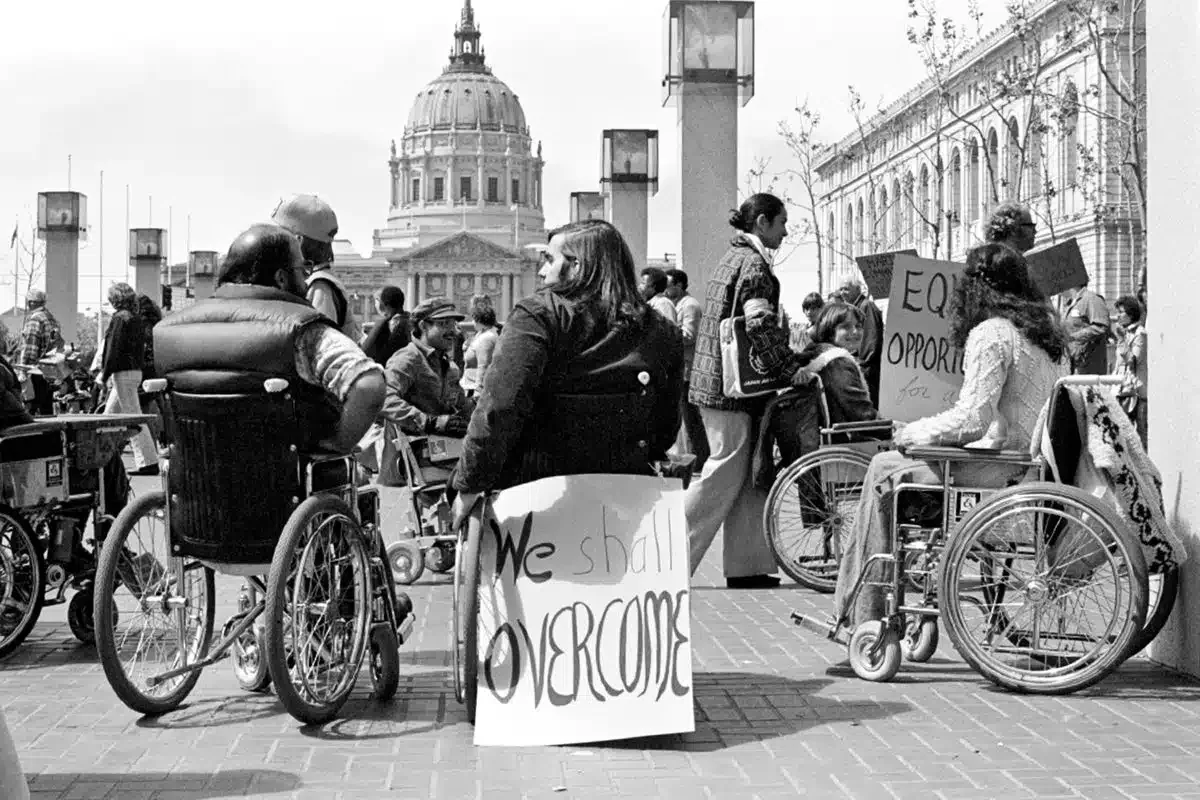
What followed was a series of protest actions in San Francisco seeking the implementation of Section 504 of the Rehabilitation Act in 1977, which depended on the country’s Secretary of Education. Section 504 involved not only access to services but a prohibition on disability discrimination by any organisation receiving federal funds. Its implementation was possible only through the leading role of persons with disabilities themselves, who placed the issue in the public eye through protest: travelling en masse to a national political centre, blocking urban traffic, occupying a public building, going on hunger strike, and openly confronting the Secretary of Education with the obsolescence of government-backed segregation. Sustaining the occupations and strikes would not have been possible without food support from the Black Panthers[2], who expressed solidarity with their struggle (ShareAmerica, 2017; Disability Social History Project, n.d.), reflecting identification with their claims and support for their recognition.
This was not the only protest in the country. Denver also witnessed actions associated with the emergence of the disability movement. In 1978, wheelchair users organised through American Disabled for Attendant Programs Today (ADAPT) protested for access to mass bus transportation, putting themselves at risk and being prepared for arrest. It was not the only organised action they carried out—they also forced the construction of ramps in the city—but it was particularly important because of its contentious character (Worthington, 2017).
Through these actions, organised persons with disabilities placed responsibility for their situation on the organisation of society, which imposed limits on their lives, and on State institutions, which refused to consider the demands of those who had “awakened”. Movement members came to understand themselves as a group experiencing the same injustices: they had constituted themselves as a political subject.
Beyond the formal and institutional demands being made, organised persons with disabilities engaged in politics on a major scale and achieved enormous changes. First, they came to be seen as people with agency rather than as people who simply needed care and protection in order to live, and as people capable not only of acting but also of raising issues and demanding change. Second, disability came to be understood not as a problem caused exclusively by a biomedical factor, but as a social issue in which society as a whole contributes to barriers by failing to create the conditions needed for people to develop their capacities. Third, persons with disabilities demonstrated that they are capable of expressing their own needs and demanding their rights without mediation by authorities or family members.
-
Ripple effects, different contexts and less mobilisation [3]
Although the United States was not the first place where persons with disabilities organised in pursuit of autonomy, it was the setting for a major organised and contentious mobilisation led by persons with disabilities themselves. This inspired action in other parts of the world, although each context had its own characteristics. The United States was undergoing major changes involving foreign policy and domestic struggles against oppressive relations that could no longer be postponed, including feminist demands and the sexual revolution, African American organising against structural racism, and cultural changes that challenged established authority. This was the environment surrounding the movement, and it framed its demands as a struggle for “civil rights”.
In Europe, the situation was different. The most frequently recounted experience is that of the United Kingdom, where a group of activists obtained funding to travel to the United States and learn directly from ILM activists (Evans, 2003). Because the welfare state was the dominant political model in Europe after the Second World War (Farge, 2007), there was already a social-protection system within which collective action followed a more institutionalised rather than contentious path. Activists focused principally on two demands: housing and personal assistance. Their experience therefore centred more on volunteer action, independent living and the expansion of activist networks (Evans, 2003).
This produced an important conceptual shift and concrete policies. The Union of the Physically Impaired Against Segregation (UPIAS) played an important role in redirecting the welfare approach toward rights in 1974. It defined the social model by linking physical impairment with social barriers, an approach disseminated through publication of the “Fundamental Principles of Disability”, and in subsequent years incorporated additional perspectives such as the concerns of women with disabilities (Disability - Equality, 2020). In the 1990s, organised persons with disabilities worked through parliamentary and civil-society networks to promote the Direct Payments Act, enabling people to receive funds with which they could purchase support services of their choice in the market. This was a way of influencing a specific mechanism, but not one of lesser impact (Disability - Equality, 2020).
The year 1981 was crucial because it marked the internationalisation of disability activism. The first congress of Disabled Peoples’ International (DPI)[4]was held in Singapore and brought together 400 delegates from different parts of the world (Oliver and Barnes, 2012). For DPI, change could come only through strengthening grassroots social organisations and raising social awareness of disability, and organisations emerging around the world embraced the slogan “Nothing about us without us” (Oliver and Barnes, 2012). Global expansion was supported by transnational organisations such as the UN, WHO, WTO and IMF (Oliver and Barnes, 2012).
In Latin America, this ripple effect arrived in part through the establishment of the International Year of Disabled Persons in 1981. After disability organising had previously taken place in settings such as sports clubs, a form of activism emerged encouraged by the institutionalisation of rights through the United Nations initiative (Berman, 2003; Ferrante, 2018). Awareness-raising and funding helped establish Centres for Independent Living in Brazil, complementing the movement of persons with disabilities by providing community services specifically for this population. In other countries, by contrast, the concept of “independent living” was not necessarily used by persons with disabilities, activists or service providers, where ideas of “integration” were more common (Berman, 2003).
Argentina provides an illustrative case for our region. During the 1980s and 1990s, organisations formed in opposition to policies of confinement were often created by parents of persons with disabilities and later became prominent, before tending to specialise around specific disabilities (Fernández, 2018). The new century began with specific cases seeking recognition of rights through litigation, brought or supported by particular institutions (Arcidiácono and Barrera, 2018). This occurred against a political-economic background of neoliberal structural adjustment alongside a precarious State response to the existence of new rights and mechanisms for guaranteeing them (Arcidiácono and Barrera, 2018). A change can therefore be seen in the mechanisms used to seek recognition: from collective organisation in the twentieth century to individual litigation, which can nevertheless affect others through the creation of precedents.
Argentina also has an interesting history because of the degree of politicisation and the demands of organised struggle. Fernández (2018) recounts that in the 1970s the Peronist Front of Disabled People denounced the discourse of charitable workshops and the accompanying conditions of labour confinement for persons with disabilities. In 1974 it occupied workshop facilities while advocating legislation that would place workers in ordinary workplaces. The author also describes mobilisations in Buenos Aires in the 1990s seeking changes to lift doors that restricted wheelchair access; these culminated in legislation on building accessibility for people with different disabilities. Fernández also notes that this form of protest has increasingly been replaced by public-space awareness-raising, online social networks and the presentation of legislative proposals (Fernández, 2018). A third important experience is MOSFA, the Movement of Deaf Feminist Women of Argentina, which achieved sign-language interpretation in public abortion debates in 2018 (Fernández, 2018).
In Latin America, however, there remains a general tendency to appeal to charity rather than demand accessible public services (Berman, 2003) that place rights above an altruistic perspective. The clearest example is the telethon model, where criticism is small compared with the support of major corporations that sustains its development and dissemination while the State remains largely passive. More information is also needed on the contexts in which disability social organisations operate in our region under neoliberal hegemony, which shapes not only State action but also the tactics and strategies of those organisations.
-
The disability movement in Peru
In Peru, the national movement of persons with disabilities still needs to be traced in greater detail. Nevertheless, some elements help us begin to reconstruct this collective trajectory.
The 1970s were a period of organisational activity, although organisations did not always consolidate over time (Portalanza, 2007). A mobilisation in October 1980 calling for respect for the dignity and protection of disabled people culminated the following year in the founding congress of the National Federation of Disabled People of Peru (FENADIP).
The mobilisation in the United States was transforming the broader landscape and brought with it the idea of speaking about disability from the perspective of persons with disabilities themselves. In Peru, however, the discourse focused less on barriers and more on access to work and healthcare. The decade brought legislative achievements but also State incapacity to implement them (Portalanza, 2007). Collective organisation pursued parliamentary channels, first through the left (in 1985 with the Mariateguist Party for National Liberation, and in 1990 with United Left and the Socialist Party), and later also through the emerging Fujimori movement (Cambio 90 in 1990) (Portalanza, 2007).
Institutional advocacy through legislation became more established in the 1990s. Under the new Fujimori-era Constitution, the paradigm of protecting the social rights of persons with disabilities was adapted to the neoliberal economic regime, leading to the formation of a group known as the “Movement for Unitary Integration of Disabled People”, which opposed that direction. At the end of the decade, in 1999, FENADIP became the National Confederation of Disabled People of Peru (CONFENADIP). Coordination among organisations continued thereafter as a means of promoting disability-related legislation.
In the twenty-first century, during the 2010s, a further major effort arose around the prospect of a new Disability Law following ratification of the Convention on the Rights of Persons with Disabilities. Collective action began with funding to support a transition toward a human-rights approach and continued with the collection of signatures for a citizens’ legislative initiative, for which alliances were created among organisations through the Support Network for the Citizens’ Initiative (Núñez, 2019). At the same time, the fact that well-known figures were distanced from the largest organisation at the time, CONFENADIP, enabled organisations of persons with psychosocial disabilities to contribute both to collecting signatures and drafting the Regulations, while also revealing limited representation of people with severe and multiple disabilities in other spaces (Núñez, 2019).
Today, it is difficult to speak of disability movements in the same sense. Although organisations bring people together, their agendas have experienced problems similar to those faced by other forms of collective organisation in twenty-first-century Peru: stalled initiatives and occasional protests linked to specific laws, such as implementation of the Disability Law[5], opposition to its repeal (Eco Perú, 2021), consultation regarding a possible new law (DisCAPACIDAD PERÚ, 2021), or resistance to changes in the implementation of services such as education.[6]The COVID-19 pandemic also generated organised discontent, although it was relatively limited and focused on the near absence of social protection provided by the State in that context (Diario La República, 2020), in addition to the broader social lack of protection that has become almost normalised. Because these actions were recent, occasional and had limited impact, it is difficult to reconstruct the history behind them.
By way of conclusion and some perspectives
The spark that ignited mobilisation in each context had a particular meaning because it carried interpretations and ways of demanding profound change that reflected its time and social reality: from a country experiencing multiple struggles amid cultural opposition to the Vietnam War and newly visible forms of oppression (United States), to regions where a welfare state had already been established after the Second World War and struggles moved through institutional channels (Europe), or the beginning of the crisis of developmentalism and the emergence of neoliberal States (Latin America).[7]
One important point emerging from this review is that the so-called social model of disability is not merely a model for understanding disability. The social model is the result of collective struggle over the meanings attached to the lives of persons with disabilities, grounded in recognition of their autonomy. Today, it can appear reduced to a model for implementing public policies, which also extend to the private sector, while struggles are increasingly pursued individually through court cases or through organisations seeking change in the legal sphere in the hope that law will be made effective. As Oliver and Barnes (2012) note, struggles raised by the social movement have ultimately been absorbed into the agenda of global capitalism and remain marginal to political processes of change, without even resolving existing dimensions of social division.
The Latin American case shows that forms of struggle in the region have been strongly influenced by the United States because of its impact on transnational institutions, while taking diverse and dispersed forms under shared material conditions. Unlike countries of the so-called “first world”, autonomy in our region has been understood in connection with demands for social rights that States had not fully assumed even in minimal form, such as work and basic survival. This is why the material character of demands within a social understanding of disability is so important: it is not simply a “change of mindset”, but a demand to rethink society with us and to use socially available resources so that people can live autonomously and on an equal basis, beginning with the basics required for survival.
Unlike earlier models for understanding disability, the social model is a horizon located in the realm of what society ought to be, and therefore involves a struggle to enter hegemonic common sense. Adopting this perspective necessarily implies collectively organised political action. This is a difficult matter in the contemporary world because of the diversity of identities and interpretations that shape the setting for political action, whether concerning disability or any other issue. In our part of the world, what will be the spark that ignites our own fields, and how will it do so?
REFERENCES.
[1] This text repeatedly uses the term “institutionalised”. Here it refers to adopting formalised rules and mechanisms for carrying out processes through organisations socially recognised as legitimate for that purpose—in this case, the State and the existing social relations that make it possible. In the hegemonic approach to disability, “institutionalisation” also refers to confining persons with disabilities in places where they cannot exercise control over their own lives and everyday decisions (Central European University, 2006), under the so-called “medical model”.
[2] The Black Panther Party was an influential organisation formed in the United States in 1966 for African American liberation, linking racial domination with class domination in its understanding of oppression (Barganier, 2011).
[3] Here, the discussion focuses primarily on Europe and Latin America.
[4] Disabled People’s International.
[5] For example, in 2019 a protest in Metropolitan Lima drew substantial participation (China Xinhua Español, 2019).
[6] In 2016, news reports indicated that the Ministry of Education would close the Luis Braille school (RPP, 2016) while attempting legal changes concerning its educational modality.
[7] It also remains to be examined what has happened on other continents.
BIBLIOGRAPHY.
Arcidiácono, P. y Barrera, L. (2018). El activismo de la sociedad civil por la educación inclusiva en el campo judicial. Un estudio de caso. Revista Estudios Socio-Jurídicos, 20 (2). Universidad del Rosario.
Barganier, G. (2011). Fanon’s Children: The Black Panther Party and the Rise of the Crips and Bloods in Los Angeles [Tesis doctoral, Universidad de California en Berkeley]. Biblioteca Digital de la Universidad de California en Berkeley.
Central European University (2006). European Coalition for Community Living (ECCL). https://cutt.ly/J2VF96O
DeJong, G. (1979). Independent Living: From Social Movement to Analytic Paradigm. Archives of Physical Medicine and Rehabilitation, 60 (Octubre). 435 – 446.
Diario La República. (2020). “Nos mata la COVID o el hambre: personas con discapacidad visual protestan para que los dejen trabajar”. https://larepublica.pe/
Disability – Equality. (2020). “Timeline History of the Disabled People’s Movement”. http://disability-equality.org.uk/history/
DisCAPACIDAD PERÚ. (2021). “Organizaciones Exigen Legalmente Consulta Previa sobre Nueva Ley de las Personas con Discapacidad”. [Publicación de estado]. Facebook. http://discapacidadperu.com/
Eco Perú (2021, 5 de marzo). “PERSONAS CON DISCAPACIDAD REALIZARON PROTESTA”. https://www.facebook.com/EcoTv.Peru/posts/2467343970056471/
Farge, C. (2007). El Estado de bienestar. Revista Enfoques, 19 (1-2) 45-54. Universidad Adventista del Plata.
Fernández, F. (diciembre 5-7, 2018). El activismo de las personas con discapacidad en torno al espacio urbano en Argentina (ponencia). X Jornada de Sociología de la UNLP. Universidad Nacional de la Plata.
Ferrante, C. (2018) “El deporte silencioso como espacio de lucha contra el menosprecio social: su emergencia en Argentina, 1953.” XIII Jornadas de Debate Interdisciplinario en Salud y Población. Instituto de Investigaciones Gino Germani, Universidad de Buenos Aires .
Heumann, J. (2003). “Prólogo”. En García, J. (coord.) (2003). El movimiento de vida independientes: Experiencias internacionales. Fundación Luis Vives.
Martínez, K. (2003). “El Movimiento de Vida Independiente en Estados Unidos”. En García, J. (coord.) (2003). El movimiento de vida independientes: Experiencias internacionales. Fundación Luis Vives.
Noticias Xinhua [China Xinhua Español]. (2019, 3 de noviembre). Personas con discapacidad se movilizan en Perú exigiendo respeto a sus derechos Archivo de video]. https://www.youtube.com/watch?v=_q13qlnTL-U
Núñez, A. (2019). Nada acerca de nosotros, sin nosotros: Agencia y acción colectiva en las organizaciones peruanas de personas con discapacidad en torno a la creación, aprobación y reglamentación de la Ley General de la Persona con Discapacidad – Ley Nº 29973.
(Oliver, M. y Barnes, C. (2012). The new politics of disablement. Bloomsbury Academic.
O’Toole C. (s/a). “"Black Panthers saved the 504 sit-in". Disability Social History Project. https://disabilityhistory.org/2021/12/19/the-504-protests-and-the-black-panther-party/
Palacios, A. (2008). El modelo social de discapacidad: orígenes, caracterización y plasmación en la Convención Internacional sobre los Derechos de las Personas con Discapacidad. CINCA.
Portalanza, J. (2007). La razón de la memoria. CONFENADIP.
RPP. (2016, 24 de mayo). “Estudiantes invidentes toman la única escuela braille del país”. https://rpp.pe/
ShareAmerica. (2017). “Cómo 150 estadounidenses ocuparon un edificio y cambiaron la ley sobre discapacidades”. Bureau of Global Public Affairs, Gobierno Federal de Estados Unidos de América.
Worthington, D. (2017). “Meet the disabled activists from Denver who changed a nation”. The Denver Post. https://www.denverpost.com/